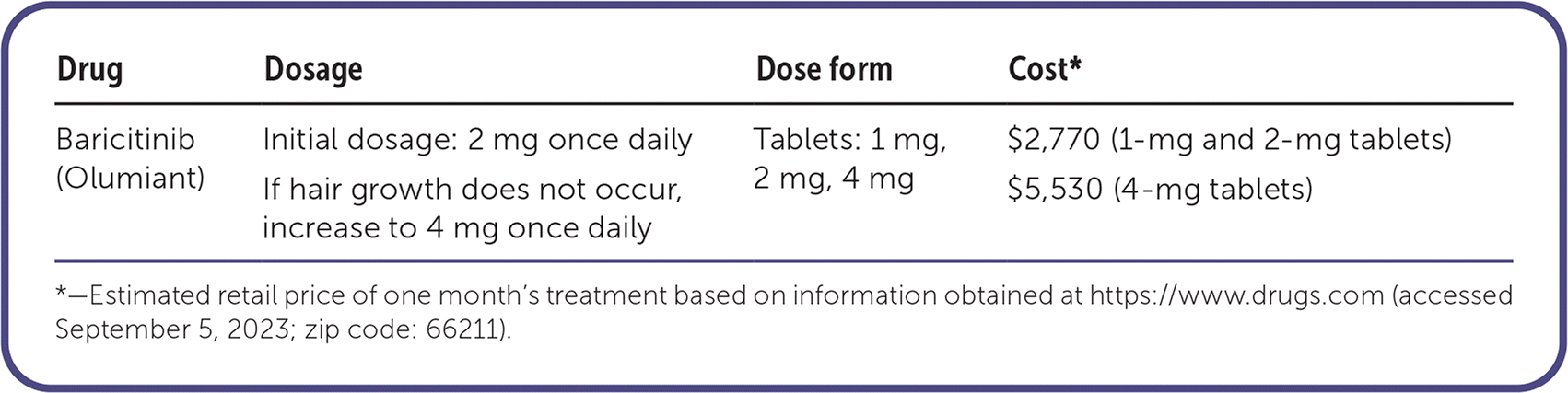
| Drug | Dosage | Dose form | Cost* |
|---|---|---|---|
| Baricitinib | Initial dosage: 2 mg once daily | Tablets: 1 mg, | $2,770 (1-mg and 2-mg tablets) |
| (Olumiant) | If hair growth does not occur, increase to 4 mg once daily | 2 mg, 4 mg | $5,530 (4-mg tablets) |
*—Estimated retail price of one month's treatment based on information obtained at https://www.drugs.com (accessed September 5, 2023; zip code: 66211).
Baricitinib (Olumiant) is labeled for the treatment of severe alopecia areata in adults.1 It is a Janus kinase inhibitor that interrupts cytokine signaling in the Janus kinase 1 and 2 pathways, leading to hair regrowth.2 Baricitinib is also labeled for the treatment of patients with certain types of rheumatoid arthritis and some patients hospitalized with COVID-19.1
Safety
Based on clinical experience with rheumatoid arthritis and COVID-19, baricitinib increases the risk of serious infections, mortality, malignancy, major cardiovascular events, and thrombosis.1 In two studies including a total of 1,200 patients who had alopecia areata and were taking 2 mg of baricitinib, 4 mg of baricitinib, or placebo, infections occurred in 1.3% of the treatment group vs. 0% in the placebo group. Death and venous thrombosis did not occur. Malignancy, including nonmelanoma skin cancers, was noted in 0.4% of patients treated with baricitinib vs. 0.6% taking placebo. Major cardiovascular events occurred in 0.5% of the treatment group and did not occur in the placebo group.2 Based on animal data, the use of baricitinib during pregnancy may cause fetal harm, and no human data support its use in pregnancy.1 Patients should not breastfeed while taking baricitinib. Before beginning to breastfeed, patients should stop taking baricitinib and wait until four days after their last dose.1 Baricitinib is not currently approved for use in children and adolescents.1
Tolerability
Across these two studies, discontinuation of treatment due to adverse effects occurred in 1.6% to 2.6% of patients taking baricitinib.2 The investigators rated most adverse effects as mild to moderate in severity. Adverse effects occurring in more than 5% of patients in both dosing groups included upper respiratory tract infections, headaches, nasopharyngitis, acne, urinary tract infections, hyperlipidemia, and increased blood creatine kinase levels.2
Effectiveness
Participants in these two studies included patients who had severe alopecia areata with at least 50% scalp baldness.2 Compared with patients taking placebo, those taking baricitinib saw an improvement in hair loss, defined in both trials as no more than 20% scalp baldness after 36 weeks of treatment. At 4 mg per day, 32% to 35% of patients will achieve this level of response (number needed to treat = 3). The 2-mg daily dosage is less effective, with 17% to 22% of patients achieving improvement (number needed to treat = 6). Hair regrowth begins approximately eight to 12 weeks after starting baricitinib, and improvement continues through 36 weeks.2 There are currently no data on safety, effectiveness, or sustained response of baricitinib beyond 76 weeks.1
Price
A 30-day supply of baricitinib costs approximately $2,770 for 1-mg or 2-mg tablets and $5,530 for 4-mg tablets. There are no similar medications for comparison. Prior authorization will likely be required by third-party plans.
Simplicity
The initial dosage of baricitinib is 2 mg once daily. It can be increased to 4 mg once daily if the patient does not have an adequate hair growth response after three months. A starting dosage of 4 mg daily can be used in patients with complete or nearly complete hair loss at baseline, and dosage reduction to 2 mg daily should occur once hair regrowth is adequate. The dosage is reduced in patients with an estimated glomerular filtration rate of less than 60 mL per minute per 1.73 m2, and baricitinib should not be used in patients with an estimated glomerular filtration rate of less than 30 mL per minute per 1.73 m2.
Bottom Line
Baricitinib may be considered for healthy adults with extensive hair loss who desire treatment, have no contraindications, and can afford the ongoing expense of treatment. Because of the high cost of baricitinib, patients should be prepared to support the medical necessity of the medication, such as documentation of 50% or more hair loss not due to other causes and the presence of alopecia areata for at least six months. Baricitinib should be prescribed by or in consultation with a dermatologist.